I never imagined that a dusty garage and an old, rusted toolbox could blow my life apart.
That Saturday started so normally that it almost hurts to remember it now. Mark had left early that morning for a fishing trip with two of his old friends, the kind of trip he’d been talking about for weeks.
He kissed my forehead before he left, smiled, and said, “Don’t work too hard while I’m gone, okay?”
I laughed and waved him off. “Then stop leaving me messes to clean up.”
He grinned. “That garage has character.”
“That garage has mold, spiders, and at least three generations of junk.”
He only chuckled, grabbed his bag, and headed out the door.
If I had known what I was about to find a few hours later, I think I would have grabbed his arm and begged him not to go. Or maybe I would have begged him to stay so he could explain himself right then and there.
But I didn’t know.
So I made coffee, tied my hair back, put on one of Mark’s old sweatshirts, and marched into the garage with a box of trash bags and the kind of determination that only comes when your husband has postponed the same chore for eight years straight.
The garage smelled like motor oil, sawdust, and old rain. Light spilled through the narrow side window in thin gray strips, catching dust in the air.
Mark’s workbench was exactly what I expected — piles of screws, bent nails, unopened paint cans, tangled extension cords, and enough random metal parts to build something terrifying by accident.
I muttered to myself as I worked. “One man does not need this many screwdrivers. This is a sickness.”
The silence answered me.
That was the first thing that felt strange. Usually, when I cleaned, I had the TV on, or music, or at least the hum of company in the house. But that day it was just me, the scrape of boxes across concrete, and the occasional thud of something heavy landing in the donate pile.
By the time I got to Mark’s oldest toolbox, my back ached, and my patience was running thin. It was shoved beneath the bench, half-hidden behind a stack of warped boards. I dragged it out with both hands.
“Seriously?” I said aloud. “What are you even hiding in here, Mark?”
I meant it as a joke.
The toolbox was heavier than it should’ve been. Rust flaked under my fingers as I lifted the latch. Inside were old wrenches, a cracked tape measure, loose bolts, and a folded shop rag stiff with age. But when I started emptying it, something caught my eye. The bottom looked uneven.
I frowned and ran my fingers along the inside edge. There was a thin piece of cardboard wedged down there, cut too neatly to belong. My pulse gave one hard, ugly thump.
“No,” I whispered, though I had no idea what I was saying no to.
I slipped my nail beneath the corner, lifted, and it came up too easily. Under it was a vacuum-sealed plastic bag.
For a second, I just stared at it.
My mouth went dry. There was something about it, the way it was hidden, the fact that it was sealed away beneath a false bottom — that made my whole body go cold. Slowly, with trembling hands, I pulled the bag out and set it on the bench.
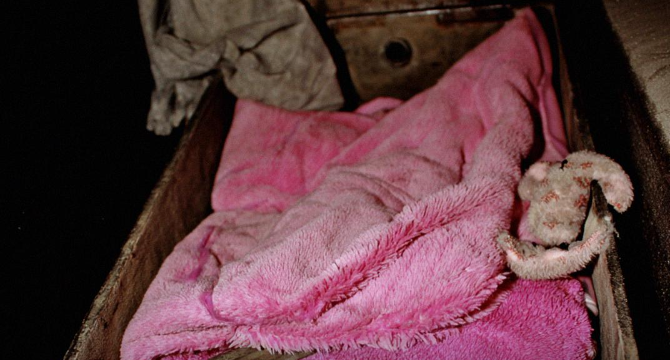
Inside was a tiny pink baby blanket.
Not new, not decorative, and not some forgotten gift from a baby shower we’d never had. This blanket was old, faded at the edges, and worn soft with use. Attached to one corner was a brittle plastic hospital tag.
I stopped breathing.
We never had children.
God knows we tried. Years of trying. Doctors, needles, test results, hope, grief, and silence. I had cried in sterile offices and in my car and once, embarrassingly, in the grocery store when I saw a woman lift a baby out of a cart. Mark had held me through all of it. Or I thought he had.
My fingers shook so badly I almost dropped the blanket as I turned the tag toward the light.
There was a date on it.
Twenty years ago.
And beneath the faded writing was a name.
I leaned closer, squinting under the harsh garage light, and when I finally saw the letters, the floor seemed to vanish under me.
My name.
My name was written there.
I stumbled back, hitting the workbench, and tools crashing to the floor. “No… no, that’s not possible,” I whispered, shaking my head. “I would remember. I would remember having a baby.”
My chest tightened as I read it again; it was dated 20 years ago. My hands trembled as I looked closer.
Chloe.
My late sister’s name was there too.
“No,” I said sharply, panic rising. “No, this doesn’t make sense.”
I dropped to my knees, grabbing the toolbox again, searching wildly. “There has to be something else. Something that explains this.”
My fingers found a bundle of papers tucked into the corner.
Receipts. Bank slips.
At first, they blurred together — until I noticed the same name repeating. Month after month. Year after year.
“What is this, Mark?” I whispered.
One slip had a note in his handwriting.
“For her care.”
Another:
“School fees.”
My stomach dropped.
“She…” I said faintly. “Who is she?”
The answer came before I could stop it.
The baby. The blanket. Chloe.
“Oh my God,” I choked, covering my mouth. My whole body started shaking. “What did you do?” I whispered into the empty garage. “What did you both do to me?”
I grabbed my phone and called Mark. It rang, then went straight to voicemail.
I called again.
He picked up. “Hey… everything okay?”
My throat felt tight. “Whose child is she?”
Silence.
Not confusion.
Silence.
“Mark,” I said, my voice breaking, “whose child is she?”
“I don’t know what you’re talking about,” he said quickly.
“Don’t lie to me!” I shouted. “I found everything… the blanket, the tag, the payments! 20 years, Mark!”
Another pause.
Then, quietly: “You weren’t supposed to find that.”
I let out a hollow laugh. “That’s your answer?”
“It’s not what you think.”
“Then tell me!” I cried. “Because it looks like you and my sister had a child behind my back!”
“Stop,” he snapped. “Don’t say it like that.”
“Like the truth?” I whispered. Tears streamed down my face. “Did you love her?”
He didn’t answer.
My voice dropped. “Where is she, Mark?”
A long breath on the other end.
“She’s safe.”
I froze. “Safe? From me?”
“You don’t understand.”
“Then explain!”
Another pause.
“I’ve been sending money to the woman who raised her.”
Raised. Not raising.
“She’s… alive?” I whispered.
“Yes.”
I closed my eyes, tears spilling freely. “Twenty years… and you never told me?”
“I was trying to protect you.”
I let out a broken laugh.
“From what?” I asked.
But deep down, I already knew. He hadn’t been protecting me; he had been hiding her. I don’t remember ending the call. One second, Mark was speaking, the next there was just silence and the sound of my own breathing, uneven and loud in the empty garage.
I stared at the blanket in my hands.
Chloe’s child.
Mark’s child.
A life they had built somewhere else… while I was right here, believing I knew them both. I let out a shaky laugh. “All those years…” I whispered. “All those years I thought you were grieving with me.”
My chest tightened.
No.
He hadn’t just been grieving. He had been hiding something.
Someone.
I forced myself to stand, gripping the edge of the workbench until my fingers hurt. The receipts were still scattered on the floor. That name and the address.
I bent down slowly and picked them up, one by one.
“Who are you?” I murmured, staring at the repeated name. “And how long have you known about me?”
A cold thought slipped in.
Did she know who I was? Or had they erased me from that story completely?
My phone buzzed suddenly in my hand, making me flinch.
Mark.
I stared at the screen as it rang. Once. Twice. Three times.
My thumb hovered over the answer button — but I didn’t move.
Not yet.
Instead, I looked back at the address on the receipt, then at the door, and back at my phone.
The ringing stopped.
A second later, a message came through.
Please don’t do anything until I get back. We need to talk.
I let out a quiet, hollow breath, then I picked up my keys.
“If you wanted to talk,” I whispered, heading for the door, “you should’ve done it twenty years ago.”
My hand tightened around the address. And this time…
I didn’t wait for his call.
Leave a Reply